


Ten months ago, we shared how TensorLinks was reimagining dental practice management with AI agents designed to handle patient engagement across voice, text, and web—so clinics and DSOs could stay responsive without overwhelming front-office teams.
Now we’re publishing the next chapter: the shift from “AI that responds” to “AI that executes.”
Because in dentistry, an agent isn’t useful unless it can act—and it isn’t safe unless it knows when it can’t.
This Part 1 is a deep dive into the most demanding surface area of all: voice.
Why “agentic + voice” is the 2025 inflection point
By late 2025, the industry has moved past “voice bots” and toward real-time, tool-using agents—systems that can hold natural conversations and also complete tasks using integrations, rules, and safeguards.
The differentiator is no longer whether AI can talk.
It’s whether AI can execute reliably with governance and an audit trail—especially in regulated workflows like healthcare.
Dentistry is the perfect proving ground. Phones are still the front door, and the operational complexity is real:
● emergencies vs routine requests
● reschedules that change same-day production
● provider preferences, chair-time constraints, appointment types
● escalation rules and human handoff
● multi-location routing for DSOs
● noisy calls, interruptions, rushed patients
So the question becomes:
Can a voice agent safely run real front-desk workflows—at speed—inside the rules of a real practice?
TensorLinks Voice Agents: designed for real-time dental operations
TensorLinks’ intent-aware AI Voice Agents are built to operate like real front-office coordinators: understanding what the patient needs, applying your scheduling and operational rules, and completing the workflow end-to-end (with human handoff when appropriate).
This isn’t “IVR with AI bolted on.” It’s an operational agent built for the realities of dental clinics and DSOs.
To keep this practical (and not a spec sheet), here’s the architecture as a simple 5-layer agentic stack—voice-first.
The Agentic Stack (5 layers) — voice-first, execution-ready

1) Security & Compliance Layer
Agentic execution without guardrails doesn’t belong in healthcare.
TensorLinks Voice Agents are designed with a HIPAA-first trust boundary:
● Verification gates before any appointment-related action
● Until identity is confirmed, the agent restricts the interaction to general clinic queries (protecting PHI by design)
● Secure-by-default behavior and audit-friendly controls
In plain terms: the agent knows what it’s allowed to do, when it’s allowed to do it, and what must be escalated.
2) AI Model Layer
Transcription is not understanding.
TensorLinks uses a voice-to-intent approach—domain-tuned for dental operations—so the agent can reliably detect high-frequency, high-impact intents like:
● new patient intake
● emergency calls
● scheduling / rescheduling / cancellations
● follow-ups and recalls
● insurance questions (contextual guidance and routing)
● general practice FAQs
This is where a call becomes structured meaning—fast enough to keep conversation natural, and accurate enough to drive correct actions downstream.
3) Operational Knowledge Layer
Most voice systems fail because they don’t know how dentistry actually runs.
This layer is where “intent” becomes “the right decision” using:
● clinic scheduling rules
● provider preferences
● chair durations and appointment types
● day-part utilization logic
● escalation criteria
● multi-location policies for DSOs
It also includes a business rules engine so organizations can configure how the agent behaves per clinic and per provider—without hardcoding workflows that break the moment real life changes.
4) Communication Layer
Voice is unforgiving. People interrupt. Call quality varies. Offices are noisy. Patients speak quickly, change their mind mid-sentence, or ask three things at once.
TensorLinks Voice Agents are built for real-time conversation—without the rigid feel of legacy IVR:
● low-latency responses for natural back-and-forth
● intelligent turn-taking (the agent knows when someone is speaking or jumping in)
● in-call context so the experience doesn’t “reset” every turn
● noise reduction to improve transcription and intent detection even in messy environments
The goal isn’t “a friendly chat.” It’s operational throughput: a call experience stable enough to run real workflows.
5) Execution + Observability Layer
This is the “agentic moment”: the agent doesn’t just answer—it executes.
TensorLinks’ scheduling and task layer can:
● schedule, cancel, reschedule
● trigger recalls and follow-ups
● notify staff
● escalate urgent cases
● route intelligently across locations for DSOs (availability, open chair time, overflow logic)
And crucially: everything is logged—creating an operational audit trail of what happened and why. That visibility is what turns autonomous execution into something teams can trust.
A real call, end-to-end (what “agentic voice” means in practice)
Here’s a simple example that shows how the stack works as one system:
Patient: “I cracked a tooth and I’m in pain. Can I come in today?”
Agentic flow:
Detects emergency intent + urgency
Applies clinic rules (emergency slot policy, provider match, chair time constraints)
Checks real-time availability and offers viable options
Confirms key details and performs verification before appointment actions
Books the appointment
Notifies staff per escalation rules (e.g., flag as urgent)
Logs the full outcome and handoffs for transparency
That’s the difference between voice automation and an agentic system:
understand → decide → execute → document, safely.
Why this matters (especially for DSOs)
For DSOs and multi-location groups, the phone isn’t just a call center—it’s a network-wide optimization problem.
A voice agent that can route intelligently based on availability, open chair capacity, specialty team readiness, and overflow rules becomes part of a larger operating system—not a single-site receptionist.
And because execution creates traceable outcomes, leadership gets a clearer operational view: what’s being handled autonomously, what is escalating to humans, and where bottlenecks or missed opportunities actually live.
Multi-voice + multi-language support (because patient experience matters)
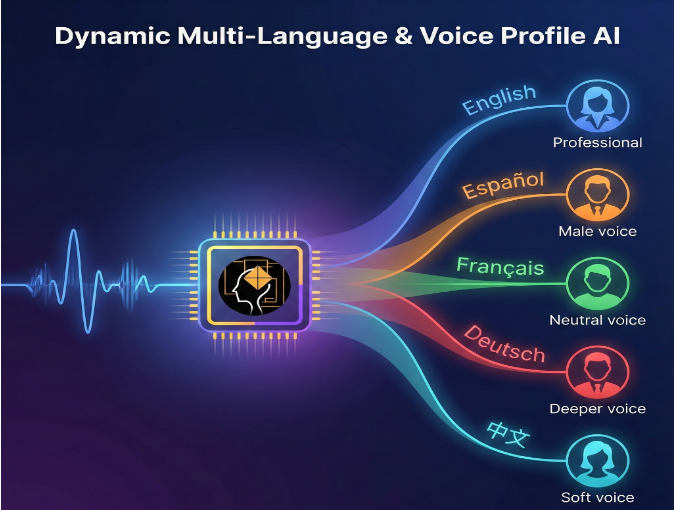
Patient experience isn’t only about speed—it’s also about comfort and clarity. TensorLinks supports multiple voice profiles so clinics can match tone to their brand, and multi-language capabilities so practices can serve diverse patient populations across regions without adding staffing burden.
The bigger shift: from call handling to operations orchestration
Voice Agents represent a shift from reactive call handling → autonomous operations orchestration.
In an environment where staffing constraints are real and patient expectations are rising, the agentic front desk isn’t about replacing humans—it’s about letting teams focus on care and high-value coordination while routine operational load is handled reliably and consistently.
What’s next in the Agentic Front Desk series
Part 1 focused on voice because it’s the hardest test.
Coming next:
● Part 2: The Agentic Core — business rules, orchestration, escalation, and governance
● Part 3: One Brain, Many Channels — voice + SMS + web + email as a unified operational system
● Part 4: Trust at Scale — safe execution patterns, auditability, and governance for multi-location DSOs
Want to see it live?
Book your demo Now or Learn more at www.tensorlinks.com
