


Stanford–Princeton’s AI-Powered Clinical Co-Pilot Is No Longer a Lab Experiment — It’s Live in Real Hospitals. And It’s Changing Everything.
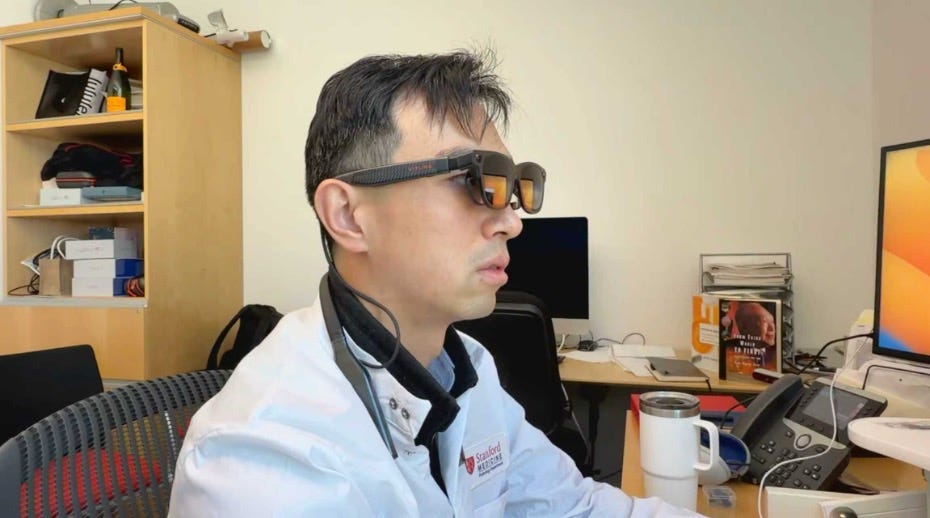
Imagine walking into a hospital where your doctor has an AI co-pilot — one that sees what they see, thinks alongside them in real time, and even assists physically during procedures. Not in a lab. Not in a simulation. In an actual hospital, with actual patients.
That future is here. It’s called MedOS, and it just went live!
Developed by the Stanford–Princeton AI Coscientist Team, with backing from collaborations with NVIDIA, Stanford Medicine, and VITURE, MedOS is a next-generation AI-XR-Cobot medical system that combines multi-agent AI reasoning, XR smart glasses, and collaborative robotics into a single, real-time clinical co-pilot. It’s not designed to replace doctors. It’s built to make them superhuman.
Officially Featured at NVIDIA GTC 2026
If the biggest names in AI are paying attention, you should be too. MedOS has been selected for an official session at NVIDIA GTC 2026 — one of the most influential AI conferences on the planet. On March 18, speakers Le Cong from Stanford University and Mengdi Wang from Princeton University will present how Stanford Medicine’s LabOS integrates multi-modal AI agents, XR smart glasses, collaborative robotics, and NVIDIA Cosmos-powered systems to bridge computational reasoning with real-world execution in healthcare.
This isn’t a concept demo at a startup pitch night. This is a formally recognized AI-XR deployment framework being showcased on the world’s biggest AI stage. When NVIDIA gives you a spotlight, the industry listens.
From Lab to Bedside: Real Hospital Deployment
Here’s where it gets real. As of the week of February 23, MedOS has been deployed at the Stanford Blood Center and the Stanford Department of Pathology. This is the moment that separates MedOS from every other AI health demo you’ve seen — it’s operating in live clinical environments, integrating into actual hospital workflows, and supporting real clinicians with real patients.
We’ve seen countless AI health tools promise to “revolutionize medicine.” MedOS is one of the first to actually walk through the hospital doors and prove it.
Smarter, Faster, and Covering Twice as Much Ground
The latest MedOS system update is nothing short of impressive. The number of supported medical disciplines has doubled. Where the system previously focused on Internal Medicine and Surgery, it now extends into Pediatrics, Gynecology, and Dermatology — with more on the horizon.
But the real game-changer? Speed. AI response latency through the XR smart glasses has dropped from 1–2 minutes down to near real-time. That means clinicians can interact with the AI continuously during procedures, receiving guidance as naturally as consulting a colleague standing right beside them. This isn’t AI that makes you wait. This is AI that keeps up.
Intelligent Gloves: When AI Gets Hands-On
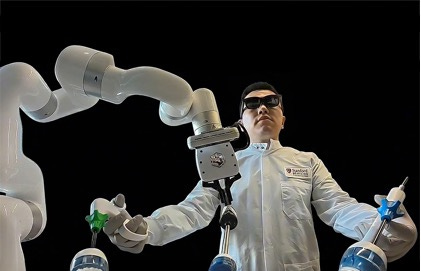
This is where MedOS takes a leap most AI systems haven’t even attempted. The newly introduced intelligent gloves and dexterous manipulation capabilities mean MedOS can now function as a precise physical assistant. Think AI-assisted suturing. AI-guided needle handling. AI-powered knot tying.
This is the bridge from AI that thinks to AI that acts — moving from perception and reasoning into actual physical execution alongside the clinician. The long-term vision is compelling: empowering doctors to perform more precise, quantitative, and efficient operations without automating decision-making away from the people who matter most.
Why You Should Be Paying Attention
Medical error remains one of the leading causes of death globally. Clinician burnout is at an all-time high. The healthcare system is stretched thin and demanding more from fewer people every year. MedOS doesn’t promise to fix all of this overnight — but it represents the most credible, technically advanced step toward an AI-augmented clinical future we’ve seen to date.
Backed by Stanford and Princeton. Powered by NVIDIA. Deployed in real hospitals. Featured at GTC 2026. The pieces are in place!
Ready to See the Future of Clinical AI?
Explore how MedOS is transforming real-world medicine — and discover what an AI co-pilot can do for healthcare.